
You smile in the mirror, and those slightly yellow, slightly darker teeth start screaming at you. They get into your head, making sure you understand it’s the first thing people notice about you. That’s why so many people see a bright, white smile as a dental goal. It’s one of the most important elements of a beautiful face. You’re beautiful anyway, but there’s a clear, research-backed link between bright, healthy smiles and higher self-esteem. That link drives the surging demand for elective cosmetic dentistry procedures.
Among these procedures, teeth whitening is the most sought-after entry-level cosmetic service, accounting for nearly 55% of all cosmetic requests in dental offices. But, patients want those immediate results. That need’s sparking a debate over which energy source is better for activating bleaching agents: Light-Emitting Diodes (LED) or lasers.
The technology varies, but the end goal stays the same: feeling better and more confident about yourself. Understanding the differences between the two and how to evaluate your best teeth whitening options is the first step on your journey to the smile you deserve. If you’re new to the process, here’s what to expect at your first teeth whitening appointment in NJ.
Quick Answer: LED vs. Laser Teeth Whitening — Which Is Better?
LED and laser teeth whitening both use 35% hydrogen peroxide to remove stains and deliver significant immediate results. Clinical studies show similar short-term whitening outcomes, though laser activation may offer slightly better color stability at six months. The best choice depends on budget, time, sensitivity risk, and long-term expectations.
The Active Ingredient Behind Professional Teeth Whitening
LED lamps and diode lasers are different methods of activating the same chemical: hydrogen peroxide. It’s the active ingredient in most professional teeth whitening sessions, regardless of the activation method.
How Hydrogen Peroxide Removes Deep Tooth Stains
Most teeth whitening uses a bleaching process, a chemical reaction to break down stains at the molecular level. Hydrogen peroxide is a potent oxidizing agent that releases oxygen radicals. These radicals penetrate the enamel to break down the bonds within stain-associated protein chains, known as chromatophores. When those bonds are disrupted, the material’s ability to reflect or absorb light changes, resulting in reduced color reflection and a noticeable whitening effect.
Why Dentists Use 35% Hydrogen Peroxide for In-Office Whitening
Most in-office procedures use 35% or 40% hydrogen peroxide concentration. That concentration’s proven to get deep enough into the enamel structure and deliver the quick results today’s patients want. It’s a pretty high concentration, though, which is why these teeth whitening treatments should only be applied by professionals and needs an external energy source (the LED or laser systems).
What Is LED Teeth Whitening and How Does It Work?
LED activation has become a staple in modern cosmetic dentistry because it’s a reliable, secure, and affordable way to activate bleaching gels.
How LED Light Activates Whitening Gel
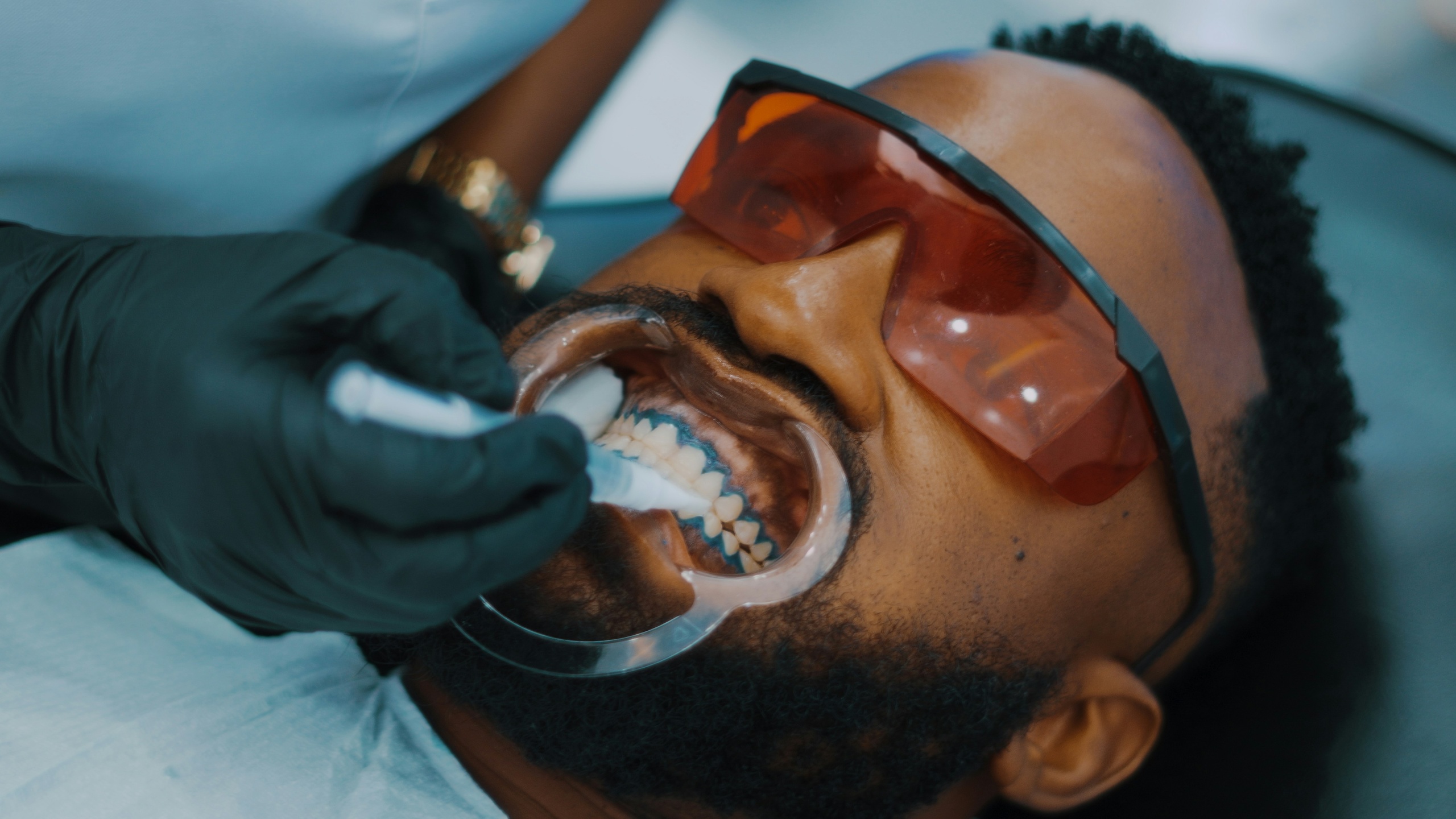
LED appliances used in dental offices emit a uniform light, usually in the blue and violet wavelength range. They generate enough energy for the hydrogen peroxide to break down those bonds without too much heat.
Is LED Teeth Whitening Safe? What Patients Should Know
One of the primary concerns with light-activated whitening is the rise in pulpal temperature, which can lead to tooth sensitivity or nerve damage. That’s why modern LED systems are usually blue or violet; red gives off too much heat and radiation. This keeps the temperature of the tooth pulp lower during the procedure, making the process safer and more comfortable for the patient.
What Is Laser Teeth Whitening and How Is It Different?
Laser-activated bleaching is often marketed as the “high-tech” alternative, utilizing specific wavelengths of light to achieve high-precision results. Like LED systems, laser activation is simply another method used in professional teeth whitening to speed up the peroxide’s work.
How Diode Lasers Speed up Teeth Whitening
Diode lasers are the most common lasers used for teeth whitening. These systems use selective diode laser light to speed up the decomposition of the peroxide gel. At more concentrated and specific wavelengths (such as 940 nm), the laser’s better at triggering the release of bleaching radicals than broad-spectrum light sources.
Is Laser Teeth Whitening Faster Than LED?
One of the primary clinical advantages of laser teeth whitening is its ability to shorten the duration of the bleaching session. The laser is incredibly efficient at decomposing the peroxide, so it takes less time than LED or non-activated methods. There’s also some research to suggest diode laser teeth whitening prevents unnecessary changes to enamel structure.
LED vs. Laser Teeth Whitening: Do They Produce the Same Results?
When patients ask which method is “better,” the scientific data suggests that in the short term, the choice really hinges on personal preference.
Clinical Studies: LED and Laser Whitening Compared
Clinical evaluations comparing 35% hydrogen peroxide activated by LED versus laser sources have found that both methods produce significant color changes in stained teeth. Statistical analysis shows no significant difference between the immediate whitening effects of either.
Which Method Delivers the Brightest Immediate Results?
In controlled studies, both LED and laser groups demonstrated immediate and substantial results that met the demand for rapid aesthetic improvement. From a purely clinical standpoint, the two energy sources are considered “equivalent” in their ability to deliver a bright, “Hollywood Smile” in a single office visit.
| Feature | LED Teeth Whitening | Laser Teeth Whitening |
| Active Ingredient | 35% hydrogen peroxide | 35% hydrogen peroxide |
| Energy Source | Blue/violet LED light | Diode laser (e.g., 940 nm) |
| Immediate Results | Significant whitening in one visit | Significant whitening in one visit |
| Treatment Speed | Standard in-office duration | May reduce chair time slightly |
| Six-Month Stability | Mild color regression possible | Slightly less regression at six months |
| Sensitivity Risk | Temporary sensitivity possible | Temporary sensitivity possible |
| Cost | Generally more affordable | Typically higher due to equipment precision |
How Long Do Teeth Whitening Results Really Last?
The biggest question with any teeth whitening procedure is the long-term stability. The dentistry community calls this color regression, or the “rebound effect.”
You can’t overlook longevity when you’re making teeth whitening cost considerations. Maintaining results is part of protecting your investment, just like discussed in how to protect your smile investment in New Jersey.
What Is Color Regression After Teeth Whitening?
Color regression is the phenomenon where teeth slowly begin to revert toward their original, darker shade after the bleaching process. The chemical bonds that were disrupted during the procedure reform, or the enamel remineralizes.
Does Laser Teeth Whitening Last Longer Than LED?
While both methods show effective initial color change, the stability of that shade begins to diverge at the six-month mark. Research has revealed that laser groups showed slightly less “rebound” compared to LED groups after six months.
Scientists think it’s because the diode lasers activate the peroxide for longer durations and operate at greater wavelengths. Neither group will permanently sustain the whitening effect, but the laser activation’s results consistently lasted slightly longer.
Does Teeth Whitening Cause Sensitivity?
Regardless of the method you choose, it is important to be aware of the most common side effect: tooth sensitivity.
How Common Is Sensitivity After Professional Whitening?
Clinical data indicates that tooth sensitivity affects between 30% and 78% of patients undergoing professional bleaching. This sensitivity is generally mild to moderate and is classified as “transient,” meaning it usually resolves within 24 to 48 hours after the treatment.
How to Reduce Tooth Sensitivity After Whitening
If your teeth are already sensitive, it might be worth discussing lower concentrations of HP with your dentist. That baseline 35-40% provides the fastest results, but you can achieve similar results at lower concentrations. It’ll just take longer, but it’ll be worth the reduced sensitivity. After treatment, following professional guidance like what’s outlined in how to keep your smile bright after teeth whitening in North Jersey can help extend results.
How to Choose Between LED and Laser Teeth Whitening
The decision between LED and laser teeth whitening does not have to be a binary choice based solely on a fraction of a shade’s difference in stability.
Which Whitening Method Is Best for Your Smile Goals?
Finding satisfaction with your smile is inherently a complex, subjective process. Both processes deliver comparable results, with one having a slight advantage in longevity. Thus, the best method is the one you as a patient personally prefer.
What to Consider Before Choosing LED or Laser Whitening
- Budget: LED whitening is generally more affordable and widely available in most general practices.
- Time: If you are looking for the shortest possible time in the dental chair, laser activation may offer a slight speed advantage.
- Longevity: If you are concerned about color regression six months down the line, laser whitening has shown slightly better stability.
- Sensitivity: Opt for LED if you have sensitive teeth, as its lower heat generation may reduce post-treatment discomfort.
Key Takeaways: LED vs. Laser Teeth Whitening
- Both methods use 35% hydrogen peroxide as the active whitening agent
- LED and laser whitening produce comparable immediate results
- Laser activation may offer slightly less color regression after six months
- Tooth sensitivity affects 30–78% of patients but is usually temporary
- Lower-concentration at-home treatments reduce sensitivity but need more time
- The best option depends on budget, chair time, and desired longevity
Which Whitening Option Is Right for You?
Both LED and laser teeth whitening activated by 35% hydrogen peroxide are safe, efficient, and scientifically proven to provide immediate results. While the laser method offers a minor edge in long-term color stability, both are world-class options for achieving your perfect smile.
If you’re weighing cosmetic upgrades more broadly, you may also find value in understanding the true cost of skipping the dentist and how preventive care supports long-term oral health.
Ultimately, a bright smile is a reflection of your inner self. The real return on your investment isn’t just a whiter shade of enamel. It’s the boost in confidence that allows you to show your emotions and interact with the world more freely.
Still have questions? You may want to review the top 5 myths about teeth whitening before making your decision.
Ready for your brightest smile? Schedule a consultation with your dental provider today to discuss your unique goals and determine whether LED or laser whitening is the right path for your new look.
Resources
Abbasi MS, Lal A, Das G, Salman F, Akram A, Ahmed AR, Maqsood A, Ahmed N. Impact of Social Media on Aesthetic Dentistry: General Practitioners’ Perspectives. Healthcare. 2022; 10(10):2055. https://doi.org/10.3390/healthcare10102055
Borges CM, Krishnamurthy M. Are We Getting Any Better? A Critical Analysis of Selected Healthy People 2020 Oral Health Indicators in 1999–2004 and 2013–2016, USA. International Journal of Environmental Research and Public Health. 2022; 19(9):5250. https://doi.org/10.3390/ijerph19095250
Oommen T, Arya A, Jahangeer B, et al. (September 21, 2024) An In-Vitro Study on the Impact of Light-Emitting Diode (LED) and Laser-Activated Bleaching Techniques on the Color Change of Artificially Stained Teeth at Varying Time Intervals. Cureus 16(9): e69851. doi:10.7759/cureus.69851