
Two appointments without drilling for a new smile sounds like an incredible deal. That’s the Lumineers pitch, and certain patients experience those results. But they’re not the best fit for everyone, and in the wrong patients, they can become more of a burden.
Before you sit down for a cosmetic consultation, it helps to know what actually separates these two options. It’s also worth understanding the difference between real results and marketing language.
If you are not sure a porcelain option is even the right tier of treatment, it is worth asking “how does composite bonding compare?” before moving up to either option. Patients already deciding between porcelain options should read on to learn what the difference looks like.
Quick Answer: Lumineers vs Veneers
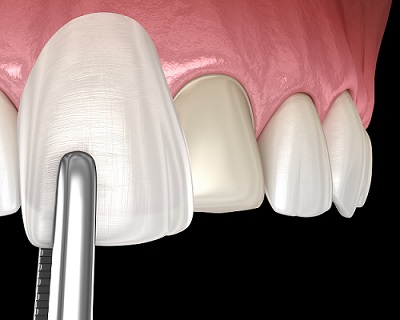
Lumineers are a brand of ultra-thin, no-prep porcelain veneer. They sit over your existing teeth with little to no enamel removal, the process usually takes two appointments, and the result is technically reversible. Traditional porcelain veneers require a thin layer of enamel to be removed first, are thicker, last longer, and handle more demanding cosmetic cases such as significant discoloration, chips, shape changes, or uneven lengths that Lumineers cannot reliably mask.
Neither option is universally better. The right choice depends on the condition of your teeth, what you are trying to fix, and how long you want the result to hold up.
What Are Lumineers, Exactly?
Lumineers are a patented dental veneer brand manufactured by Apex Dental Laboratory Group in Lompoc, California, and marketed by DenMat. They are made from Cerinate porcelain, a leucite-reinforced pressed ceramic, and can be fabricated as thin as 0.2 mm. That’s about the same thickness as a contact lens, and the foundation of the no-prep claim.
With so little added thickness to work around, there is often no need to shave enamel first. The process usually runs two appointments. At the first, impressions or digital scans are taken and sent to the lab. At the second, the finished Lumineers are bonded in place.
Because no enamel is removed in most cases, the procedure is technically reversible. The veneers can be debonded and the underlying tooth is often left intact.
The ideal Lumineers candidate has healthy teeth that are already reasonably shaped. Mild staining, small gaps, and slightly uneven edges are usually the kind of concerns they handle best. The teeth also need enough natural enamel for a clean bond, and the existing color needs to be light enough that a thin porcelain shell can mask it.
Severe discoloration on the underlying teeth is where Lumineers start to struggle. The thinner the veneer, the less opaque it is, so the original shade shows through more easily.
The Cerinate Porcelain Difference
Cerinate is a feldspathic pressable porcelain. Its low-viscosity glass composition allows it to be pressed into very thin forms without losing structural integrity. At 216 MPa, the leucite reinforcement gives it more fracture resistance than standard feldspathic ceramics at the same thickness.
Translucency is both Cerinate’s biggest strength and its biggest weakness. Traditional veneers are more than twice as thick at 0.5 to 0.7mm, which makes them naturally more opaque. That opacity is what makes conventional veneers better at blocking tetracycline-stained or heavily discolored teeth. 0.2mm of Cerinate can’t do that to the same degree because they let too much light through.
How Traditional Porcelain Veneers Work
Traditional veneers start with preparation: removing a small layer of enamel, usually 0.3-0.5mm, from the front surface of the tooth. This makes the tooth permanently thinner, and it will always need a restoration going forward. That’s the trade-off for a stronger bond surface and enough room for a thicker, more opaque, longer-lasting restoration.
Once prepared, impressions or scans go to a dental lab. A temporary set of veneers is placed in the meantime. When the final porcelain pieces return, they are bonded in place and adjusted for fit, color, and bite. The full process usually takes two to three appointments over a few weeks.
The porcelain veneers at the Silverstrom Group are fabricated in an in-house laboratory. The dentists oversee every stage of the fabrication process directly. Their human input forces consistent color and fit across several veneers, which is much harder to guarantee through an external lab full of technicians who don’t know your smile.
Why Prep Matters More Than You Think
Removing enamel feels like a downside, and patients often resist it. The clinical picture is more nuanced. Enamel bonding is significantly more durable than bonding to dentin or to an unprepared surface. The prep creates a mechanical and chemical anchor that helps keep the veneer in place longer and reduces the risk of debonding.
A systematic review by Alenezi et al. (2021) found enamel-bonded veneers had survival rates of 99%, compared to lower rates when veneers were bonded to dentin or composite resin. Feldspathic veneers on prepared teeth have been tracked for up to 21 years with strong outcomes.
Lumineers, reviewed independently by Dental Advisor over a 4-year clinical period, showed good performance too. The difference is that no-prep veneers still do not have the same depth of long-term independent data behind them.
Lumineers vs Veneers Side by Side
The main difference between Lumineers and traditional veneers is the thickness. Every other difference between the two stems from the gap in thickness.
Both options lie on opposite ends of the preparation spectrum. Lumineers usually require little to no enamel removal, while traditional veneers require a permanent reduction of the tooth surface.
Traditional veneers can fully mask dark staining, heavier discoloration, chips, and significant shape irregularities. Lumineers are limited by their translucency and work best on lighter, milder cases.
Traditional veneers on prepared enamel routinely last 10 to 20 years with proper care. Lumineers carry a manufacturer claim of 20 years, but independent clinical follow-up data is more limited and real-world performance depends heavily on case selection.
Lumineers often run slightly lower per tooth, partly because chair time is shorter and the process is simpler. Both are cosmetic procedures and are not usually covered by insurance. Over a 20-year window, that gap can narrow if traditional veneers outlast Lumineers by a meaningful margin.
Both options usually require two appointments. Traditional veneers sometimes require a third for refinement or adjustments.
If you are dealing with more than one cosmetic issue at once, a smile makeover consultation may make more sense than choosing between these two options.
Which Cases Each Option Handles Best
Lumineers work best when teeth are healthy and well-shaped, staining is mild, gaps are small, and the patient wants to avoid enamel removal or values the option to reverse the procedure later.
Traditional veneers are the better call when teeth have heavy intrinsic staining from tetracycline, fluorosis, or trauma. They are also stronger when there is significant chipping, obvious shape irregularity, or a need for consistent color blocking across a full smile. They also make more sense when the goal is a result built to last 15 to 20 years.
Neither option is appropriate when there is active gum disease, structural damage that calls for a crown rather than a veneer, or heavy bruxism without a night guard. Grinding creates forces that stress the veneer-tooth bond regardless of type.
Cost, Longevity, and What to Ask Your Dentist
Cost varies by market, number of teeth, and lab. In New Jersey, traditional porcelain veneers typically run over $1,000 per tooth. Lumineers often come in slightly below that range. Neither figure is fixed. A full smile involving eight to ten veneers is a very different conversation from covering two front teeth.
If traditional veneers last 18 to 20 years and Lumineers need replacement at 10 to 12, the longevity of traditional veneers might outweigh the lower-per tooth cost of Lumineers in the long term. A dentist who offers both options should be able to walk through that calculation for your case specifically, without steering you toward one based on anything other than the teeth in front of them.
Reviewing common cosmetic dentistry questions before your appointment can still be useful, but the more important thing is walking in ready to ask direct questions about masking ability, longevity, and whether your tooth color or bite makes one option a weaker fit.
How to Know Which One Is Right for You
The only way to know for sure is by asking your dentist. They know you and your teeth better than any comparison article ever could. But it helps to know the framework they use to make these decisions. Usually, it comes down to four things: severity of cosmetic concerns, reversibility, how long you expect to keep the result, and what the long-term cost looks like.
If your concerns are mild and your teeth are healthy, Lumineers may be the right call. If you are dealing with anything more demanding, or you want a result with two decades of clinical data behind it, traditional veneers are usually the more reliable investment.
Lumineers vs Veneers: Questions to Bring to Your Consultation
- Do my teeth need preparation for either option, and why?
- Can Lumineers cover my specific type of staining, and what will they look like over my underlying tooth color?
- What longevity do you expect for each in my case specifically?
- Do you fabricate veneers in-house or send them to an external lab?
- Would composite bonding be a reasonable alternative at my level of concern?
- If I choose Lumineers and later want traditional veneers, is that transition straightforward?
The Silverstrom Group in Livingston, NJ offers both Lumineers and traditional porcelain veneers, and can give you a direct comparison based on what your teeth actually need.
Frequently Asked Questions
Are Lumineers the same as veneers?
Lumineers are a type of veneer, specifically a brand of ultra-thin, no-prep porcelain veneer made from Cerinate ceramic. All Lumineers are veneers, but not all veneers are Lumineers. Traditional porcelain veneers are thicker, require enamel prep, and have a longer documented lifespan.
Can Lumineers be removed?
Technically, yes. Because little to no enamel is removed during placement, the underlying tooth is often left largely unchanged and the restoration can be debonded. In practice, the adhesive process can still affect enamel slightly, so “fully reversible” is not always perfectly accurate, but it is meaningfully more reversible than a traditional veneer.
Do Lumineers look fake?
They can if they are placed over a darker tooth. The thinness that makes them appealing also limits their opacity. On the right candidate they can look very natural. On a patient with significant discoloration, the result can look unnaturally washed out.
Can you get Lumineers if you grind your teeth?
Usually not without careful case selection and some kind of protection plan. Heavy bruxism puts repeated stress on the veneer-tooth bond, regardless of restoration. If grinding is part of the picture, your dentist should address that directly before recommending either option.
Are traditional veneers painful?
The prep is done under local anesthetic, so the procedure itself is not painful. Most patients feel some sensitivity in the days after preparation, which usually settles once the final veneers are bonded.
Which is cheaper, Lumineers or veneers?
Lumineers usually cost a little less per tooth upfront. Over a longer period, traditional veneers may still be the better value if they last several years longer.
Which Option is Right for You?
For mild cosmetic concerns on healthy, light-colored teeth, Lumineers can produce a meaningful change without permanently altering enamel. For significant discoloration, structural irregularity, or a result expected to hold for 15 to 20 years, traditional porcelain veneers are the more reliable investment.
The real decision usually comes down to what your existing teeth can support. A dentist who offers both options should be able to give you a straight answer based on your case, not a preference for one product.
Sources
- Alenezi A, Alsweed M, Alsidrani S, Chrcanovic BR. Long-Term Survival and Complication Rates of Porcelain Laminate Veneers in Clinical Studies: A Systematic Review. J Clin Med. 2021;10(5):1074. Published 2021 Mar 5. doi:10.3390/jcm10051074
- Lumineers.com. Lumineers Dental Veneers — Official Patient Site. https://www.lumineers.com/
- Dental Advisor. Lumineers by Cerinate: Clinical Evaluation. https://dentaladvisor.com/clinical-evaluation/lumineers-by-cerinate/
- Watson, K. Healthline. Veneers vs. Lumineers (2019). https://www.healthline.com/health/veneers-vs-lumineers
- American Academy of Cosmetic Dentistry. https://aacd.com/